ICO Optics & Refraction
ICO Part B Question Bank
3,000 MCQs on optics, refraction, and instruments—the focused 60-question paper where lens arithmetic and clinical optics really matter. Built with a practising ophthalmologist.
50 questions free for 3 days. No card needed.
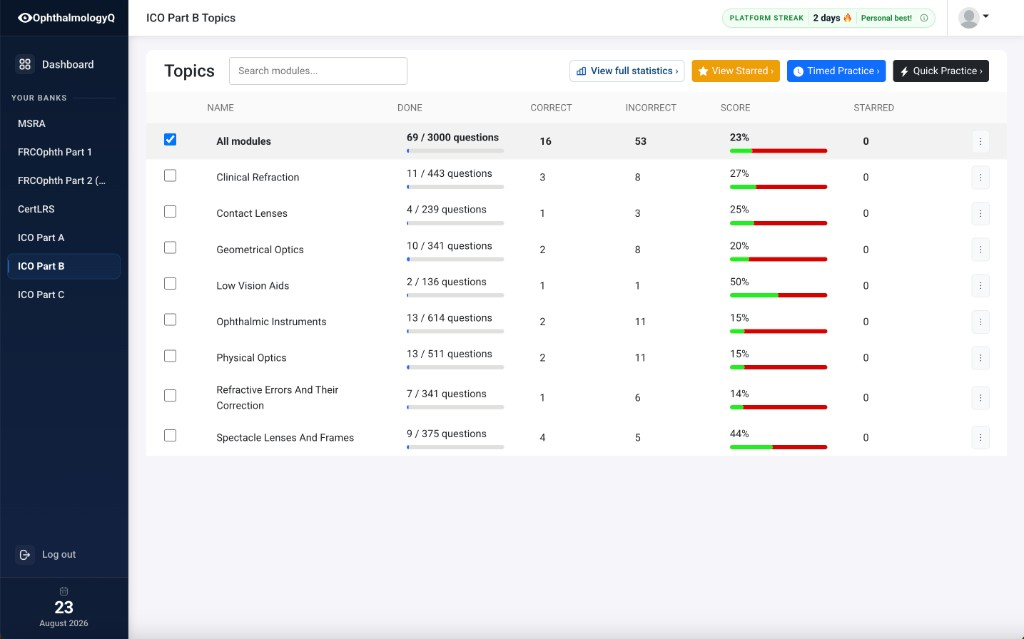
Part B is Optics, Refraction and Instruments—60 MCQs in 90 minutes, sat once you have passed Visual Sciences (or an ICO-recognised equivalent). It is narrower than Part A but technically demanding: candidates often stumble on refraction maths, lens combinations, and instrument optics rather than lack of clinical experience.
Use this bank to drill the optics syllabus directly—3,000 questions with rationales that show the working, so you are not guessing on exam day.
What's included
Optics and refraction practice aimed at Part B—not a general question mix diluted across other exams.
3,000 optics MCQs
Geometric and clinical optics, ametropia, refraction technique, spectacles, contact lenses, and low vision
A shorter, sharper exam
Part B is only 60 MCQs in 90 minutes—every stem counts, and optics detail catches people out
Worked-through rationales
Lens formulae, sign conventions, and refraction pitfalls explained step by step—not just the right option
Instruments and imaging
Keratometry, OCT, autorefractors, and the kit you need to recognise for the instruments section of the syllabus
After Part A
For trainees who have cleared Visual Sciences and now need dedicated optics and refraction practice
Drill weak optics topics
Analytics highlight where you are losing marks—spherical equivalent, prisms, or instrument optics, for example
What Part B tests
Four-option single-best-answer MCQs, 90 minutes, no penalty for wrong answers. You must pass Part B (with Part A) before booking Part C. The paper draws on the ICO optics and refraction syllabus—clinical optics, corrective lenses, low vision, and the ophthalmic instruments you use and interpret in clinic—not subspecialty management scenarios.
Simple Pricing
ICO Part B Question Bank
Includes:
 3,000 optics & refraction MCQs
- Instrument and imaging coverage
- Step-by-step optics explanations
Not ready to buy? Try 50 questions free for 3 days. No card needed.